



Hearing aids today do far more than make sound louder; they actively reshape how people stay connected in a digital-first world. With Bluetooth-enabled hearing aids, conversations can move seamlessly from phone calls to television audio and even streaming apps, all without extra devices or effort.
But as these features become more advanced, a practical question naturally arises: do these upgrades genuinely improve everyday hearing experiences, or are they simply added complexity?
Understanding where this technology truly adds value is key to making the right choice.
Bluetooth hearing aids are wireless hearing devices that can communicate directly with other electronics around you, the same way wireless earbuds pair with your phone.
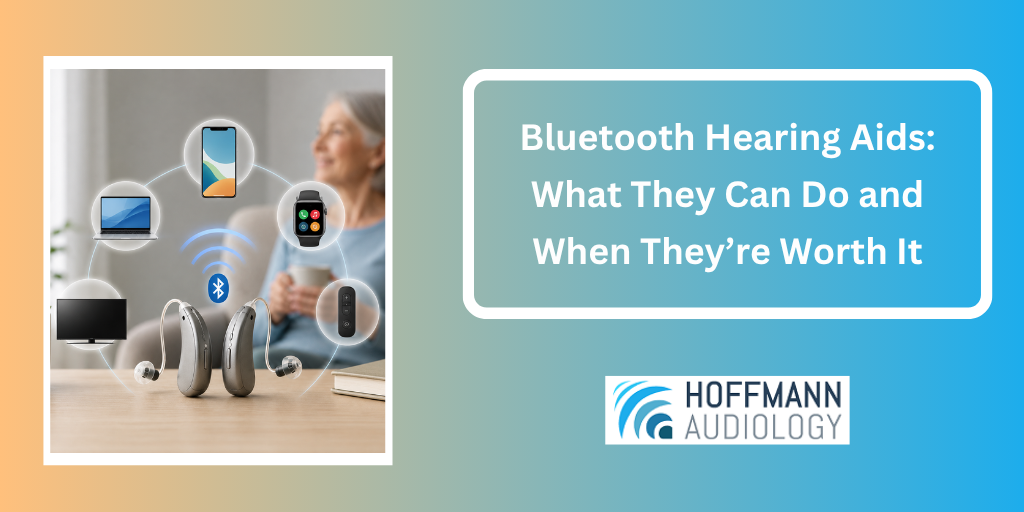
Rather than picking up every sound in the room and amplifying it equally, Bluetooth hearing aids can selectively pull audio from specific sources: your iPhone, your Android device, your smart TV, your laptop, even your smartwatch. The signal goes straight into both hearing aids simultaneously, bypassing the acoustic noise in the room entirely.
Compatible devices typically include smartphones, tablets, televisions (with or without a streaming accessory), laptops, and select wearables. Some models even connect to smart home systems.
Bluetooth functionality is designed to reduce listening effort and improve clarity across everyday situations. Here’s how these features translate into real-world benefits.
Instead of holding a phone to your ear, calls are transmitted directly into your hearing aids.
This feature is especially useful in busy environments or for individuals who struggle with clarity during phone conversations.
Television listening is one of the most common challenges for people with hearing loss.
With Bluetooth streaming:
This creates a more comfortable home environment and reduces frequent volume adjustments.
Bluetooth hearing aids also function as personal audio devices.
For users who regularly consume digital content, this adds a layer of everyday convenience.
Most smart hearing aids come with companion apps that allow users to control settings in real time.
This reduces dependency on in-clinic visits for minor adjustments.
Modern Bluetooth hearing aids combine connectivity with advanced sound processing.
This makes conversations less mentally exhausting and more natural.
Beyond features, the real value lies in how these devices improve daily life.
Key advantages include:
For many users, these improvements are not just technical; they directly impact quality of life and independence.
Bluetooth functionality is not essential for everyone, but it can be highly beneficial for specific lifestyles.
Ideal users include:
Importantly, Bluetooth features can support both mild and more advanced hearing loss, depending on the device and audiology fitting.
This is where personal needs matter more than specifications.
Bluetooth hearing aids may be worth it if:
However, for some individuals with simpler communication needs, standard hearing aids without Bluetooth may provide everything required without added complexity.
The real value lies in matching technology to lifestyle, not choosing the most advanced option by default. This is where professional audiology guidance becomes essential.
Before making a decision, several practical factors should be evaluated.
Even the most advanced hearing aid cannot perform effectively without proper fitting and customization.
A professional hearing evaluation ensures:
Audiologists play a critical role in ensuring that the chosen hearing solution is not just advanced, but appropriate.
Bluetooth hearing aids represent a major shift in modern hearing care. They do more than amplify sound; they connect users to the digital world in a seamless and practical way. From phone calls and TV streaming to app-based control and improved clarity in noise, these devices are designed to simplify everyday communication.
However, the “best” hearing aid is not defined by technology alone. It is defined by how well it fits an individual’s hearing needs, lifestyle, and comfort with technology.
Not every hearing challenge needs more effort; sometimes it needs better technology and the right guidance. At Hoffmann Audiology, we help you explore modern Bluetooth hearing solutions designed for clearer conversations, effortless streaming, and everyday ease.
Contact us today and take the next step toward a more connected, confident hearing.

Be the first to post a comment
Leave a Reply Cancel reply