



At a family dinner, the voices around the table are loud and clear. You can tell who is talking, you can hear the laughter, and you even catch the clinking of forks.
Yet when your niece asks you a question, the words arrive blurred, and you answer with a smile and a guess.
If this sounds familiar, the problem may not be volume at all. It may be clear. A different kind of hearing test measures exactly that, and the results can change what comes next.
Hearing involves two jobs. The ears detect sound, and the brain turns that sound into meaning. A standard tone test measures the first job: how soft a beep can be before you stop noticing it. It says little about the second.
Speech is a fast mix of loud vowels and quieter consonants. When some of those consonants fade, a sentence can lose the very sounds that separate “fan” from “man” or “sit” from “fit.” You hear that someone is speaking without catching what was said.
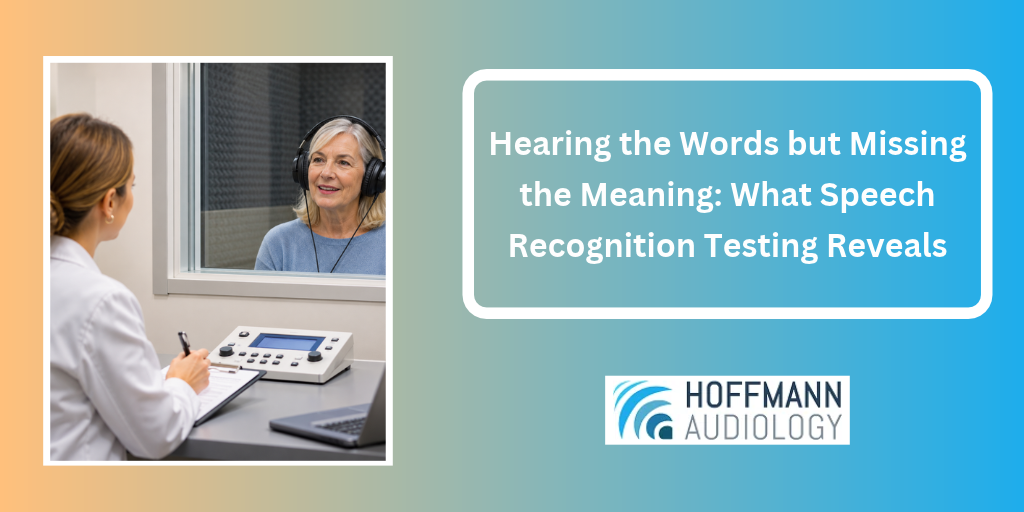
The test is straightforward. You sit in a sound booth and listen to recorded words, then repeat each one back. There are no trick questions and no studying involved. The audiologist notes which words you repeat correctly and which you miss.
Results are generally reported as a percentage of words repeated correctly. Scores can show how much clarity you retain once words are loud enough to be heard. The test also helps reveal whether the two ears are working equally well, which tone testing alone may not show.
Quiet rooms are not where most people struggle. Restaurants, car rides, and busy kitchens are. So speech in noise testing plays words against varying levels of background sound to see how you cope when listening gets harder.
Listening in noise also takes effort. When the brain spends energy filling in missing sounds, a social evening can end in a kind of tiredness that has nothing to do with the topic of conversation.
That fatigue is worth mentioning to your audiologist, because it often points to the same clarity problem the test is designed to measure.
This matters because two people with similar tone results can behave very differently in noise. One may follow a table conversation with little effort, while the other loses the thread entirely.
The noise test offers a more realistic preview of daily life than a silent booth ever could. For the device side of this challenge, see how hearing aids separate speech from background noise.
Sometimes the speech scores look better or worse than the tone chart would suggest. That mismatch is not an error. It is information. Words depend on more than the ear’s ability to detect sound, including how well the inner ear preserves detail and how the brain processes it.
An audiologist reads both sets of results together, alongside your medical background. A large difference between your two ears, or hearing that changes suddenly, calls for a prompt medical evaluation rather than a wait-and-see approach.
Not everyone notices a clarity problem as quickly as a volume problem. Watch for patterns such as:
People often adjust their lives around these habits without naming the cause. If this resembles your experience, the experience of gradual age-related hearing loss may sound familiar too.
Speech test results help shape realistic expectations. If clarity is well preserved, hearing aids may offer a strong benefit by restoring the missing sounds.
If clarity is reduced, your audiologist may explain what hearing aids can and cannot do, and may suggest strategies that go with them, such as facing speakers and choosing quieter seats.
Follow-up testing can also show whether clarity holds steady or shifts over the years.
Either way, results vary from person to person, and no test predicts the outcome precisely. What the numbers do give you is a clearer starting point. They also provide a baseline, so changes can be spotted early at later visits.
There is no studying and no special diet. Bring a short list of the moments when conversation breaks down, such as a noisy restaurant or a call on speakerphone. Specific examples give your audiologist something concrete to match against your scores.
If a family member has noticed changes in how you follow conversations, invite them along. Loved ones often spot patterns long before the person living them does, and their observations add useful context.
Tell the audiologist about any ear infections, head injuries, loud work or hobby noise, or medications that may affect hearing. Those details help explain why your results look the way they do.
If you are tired of guessing at conversations, a complete evaluation can show where the breakdown happens. Hoffmann Audiology includes speech recognition and speech in noise testing in its diagnostic hearing evaluation.
Contact us to book an appointment today.
What is a speech recognition test?
You repeat recorded words in a sound booth, and the audiologist scores how many you get right.
Is a speech in noise test different?
Yes. The words are played over varying amounts of background noise to show how you handle busy settings.
Can I hear sounds well but still struggle to understand people?
Yes. Detecting a sound and understanding a word are different tasks, and a person can struggle with the second even when volume seems fine.
Does the test hurt or take long?
No. It is a listening task, and it is included in the roughly 30-minute evaluation.
Will hearing aids fix poor word clarity?
They can help many people hear speech more clearly, but results vary, and your audiologist can explain what to expect.

Be the first to post a comment
Leave a Reply Cancel reply